
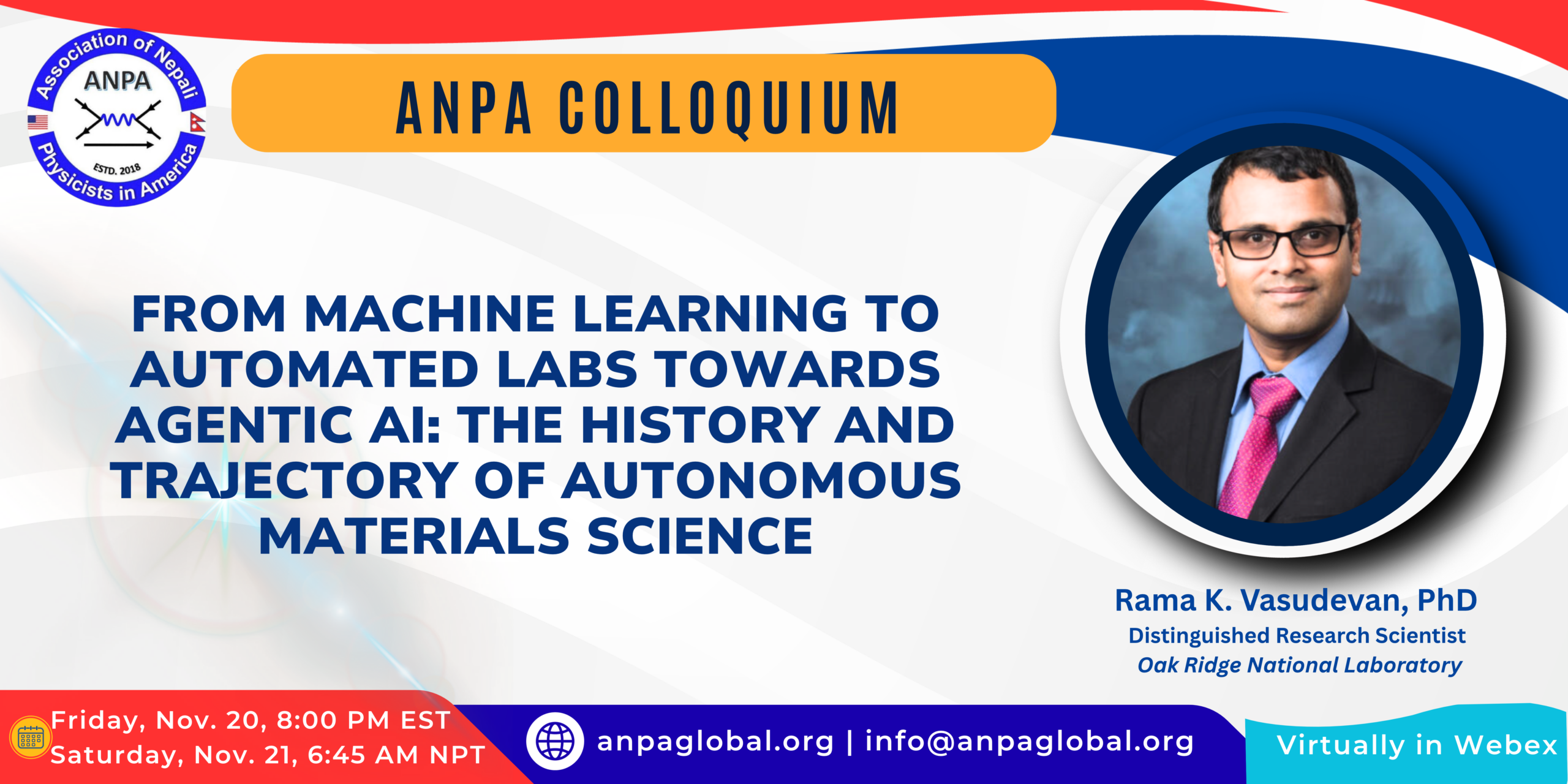
From machine learning to automated labs towards agentic AI: the history and trajectory of autonomous materials science
We are pleased to announce an upcoming colloquium featuring Dr. Rama Vasudevan from Oak Ridge National Laboratory
📅 November 20, 2026 🕗 8:00 PM (US EST): November 21, 2026 🕗 6:45 AM (Nepal Time)
Abstract:
The use of machine learning (ML) has long history in materials science, spanning decades, and interest in ML from within the materials field typically tracks corresponding cycles of boom and bust in the machine learning and artificial intelligence (AI) community. Recently, the field has been once again reinvigorated by the promise of applying large language models (LLMs) to scientific laboratories, mirroring their adoption in other aspects of society. However, automated and autonomous laboratories that use ML methods to implement decision have a history that predate LLMs, and the field must be understood in this context.
Here, I will go begin with a short history of automated and autonomous material science, beginning with the widespread expansion of computational materials science via the Materials Genome Initiative, through to applications of deep learning that enabled real-time analysis of data streams on instruments to become feasible in the late 2010s. This directly led to the rise of the autonomous laboratories, where the confluence of open-source tools, increasing computational abilities, and open hardware enabled automation of sequential decision-making tasks in scientific workflows such as microscopy and synthesis setups. I will explain the promise of autonomous laboratories not primarily in terms of potential efficiency gains, but in terms of the quantitative scientific outcomes they can deliver, with examples of rigorous physics-based theory computed during autonomous experiments to realize scientific insights in days, rather than months to years. The future of agentic science infrastructure will be briefly discussed. This work was supported by and conducted at the Center for Nanophase Materials Sciences, a US DOE Office of Science User Facility at Oak Ridge National Laboratory.
Bio:
Rama Vasudevan is a Distinguished research scientist at the Center for Nanophase Materials Sciences (CNMS) at Oak Ridge National Laboratory, where he leads the Data NanoAnalytics group. His expertise lies at the intersection of materials science and machine learning, with a focus on creating autonomous laboratories that can design, synthesize, and characterize material systems to update our scientific understanding via theory-in-the-loop. His group develops open-source tools for automated microscopy and data analysis (e.g., pycroscopy and AEcroscopy), as well as autonomous pulsed laser deposition platforms used by the CNMS user community. He is a fellow of the American Physical Society and an associate editor for npj Computational Materials.
Contact info@anpaglobal.org for Webex link. ANPA members will receive Webex link closer to the event date.
In not a member, apply here


Leave A Comment