
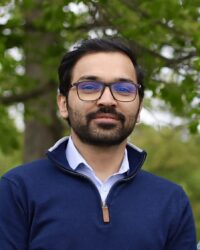
Message from Division Chair
Data science and Quantum Information Science division focuses on sharing knowledge, state-of-the-art tools, techniques, research, and emerging industry trends with machine learning applications. Machine learning tools are becoming prevalent with a growing impact across industries. Reflecting the increased relevance, this division aims to create a forum to exchange experiences and discussions on research topics and inspire collaborations, bringing people together from academia to industries.
Important Links
Conference Timeline
Invited Speaker

Decoherence in Driven Quantum Systems
Recent spectroscopic measurements on periodically driven superconducting qubits have revealed transition energies consistent with Floquet quasienergies, validating the Floquet framework for engineered quantum systems. Understanding how the effective quasienergies and associated quasi-periodic Floquet states respond to external fluctuations and environmental couplings is crucial for achieving precise control and robust operation of Floquet qubits. In this work, we leverage Floquet master equations and Floquet geometric theory to develop a theoretical framework that connects the driven frame quasienergy response to dephasing and relaxation processes. We employ complementary decompositions of the lab-frame Hamiltonian, one emphasizing the period-averaged dynamics and one emphasizing the sub-period micromotion, to characterize how the effective spectrum of the driven quantum system evolves under fluctuating drive parameters. Building on this foundation, we analyze the dephasing and relaxation dynamics, exploring the emergence of the dynamical protection under single- and multi-tone driving in superconducting quantum circuits. Our results establish experimentally accessible signatures for coherence optimization and control of driven superconducting quantum circuits in an open quantum system setting.
Division Schedule
Please look below for detailed schedule.
|
Date/Time: |
Abstract Number: ANPA2026N000102 Presenting Author: Bibek Bhandari (Invited) Co-Authors: nan Presenter's Affiliation: Chapman University, CA USA Title: Decoherence in Driven Quantum Systems Location: Virtual Presentation Show/Hide Abstract Recent spectroscopic measurements on periodically driven superconducting qubits have revealed transition energies consistent with Floquet quasienergies, validating the Floquet framework for engineered quantum systems. Understanding how the effective quasienergies and associated quasi-periodic Floquet states respond to external fluctuations and environmental couplings is crucial for achieving precise control and robust operation of Floquet qubits. In this work, we leverage Floquet master equations and Floquet geometric theory to develop a theoretical framework that connects the driven frame quasienergy response to dephasing and relaxation processes. We employ complementary decompositions of the lab-frame Hamiltonian, one emphasizing the period-averaged dynamics and one emphasizing the sub-period micromotion, to characterize how the effective spectrum of the driven quantum system evolves under fluctuating drive parameters. Building on this foundation, we analyze the dephasing and relaxation dynamics, exploring the emergence of the dynamical protection under single- and multi-tone driving in superconducting quantum circuits. Our results establish experimentally accessible signatures for coherence optimization and control of driven superconducting quantum circuits in an open quantum system setting.
|
||||||
|
Date/Time: |
Abstract Number: ANPA2026N000103 Presenting Author: Parshuram Dahal Co-Authors: nan Presenter's Affiliation: AI Research Scientist, USA Title: Agentic Multimodal Question Answering over Physics Literature and Experimental Data Location: In-Person Presentation, CDP Show/Hide Abstract Agentic Multimodal Question Answering over Physics Literature and Experimental Data
Dr. Parshuram Dahal, PhD
PhD in Atomic, Molecular and Optical Physics, University of Oklahoma (2012) | AI Research and Development Scientist, USA
In this work, I present an agentic artificial intelligence framework for physics research that enables natural-language question answering across diverse scientific sources, including journal articles in PDF form, tabular experimental datasets, web-based technical materials, and locally stored scanned or hard-copy documents. This work is motivated by a common challenge in modern physics: important knowledge is often scattered across papers, tables, plots, supplementary materials, lab records, and online repositories, making rigorous synthesis slow and difficult. My objective is to create a unified research environment in which scientists can ask complex domain questions in plain language and receive grounded, context-aware answers supported by relevant literature and data.
The proposed system combines large language models with agentic AI and agentic retrieval-augmented generation to integrate unstructured and structured scientific information. Physics papers and technical documents are ingested from PDF, website, and local storage sources, parsed into semantically meaningful chunks, and indexed for retrieval. At the same time, experimental and simulation-related tabular data are standardized and connected to analysis modules capable of filtering, comparison, aggregation, and numerical reasoning. An orchestration layer routes each user query to specialized agents responsible for literature retrieval, table-aware reasoning, evidence validation, and final response synthesis. This enables the system to answer both descriptive questions about published results and analytical questions that require linking numerical evidence with scientific interpretation.
The broader significance of this work lies in reducing the time required for literature review, experimental interpretation, and cross-source evidence synthesis while preserving traceability and scientific context. For physicists working across theory, experiment, and data-intensive research, such a system can support faster hypothesis exploration, more transparent comparison of findings, and more efficient interaction with complex research archives.
|
||||||
|
Date/Time: |
Abstract Number: ANPA2026N000104 Presenting Author: Tej Nath Lamichhane Co-Authors: nan Presenter's Affiliation: University of Central Oklahoma Title: From Classical Circuits to Quantum Architectures: Information Processing Principles in Modern Computing Systems Location: Virtual Presentation Show/Hide Abstract Modern computing systems are undergoing a paradigm shift, driven by the emergence of novel hardware architectures that extend beyond classical transistor-based circuits. This talk presents a unified perspective on circuit architecture and information processing principles across classical and quantum computing platforms. Beginning with conventional CMOS-based digital circuits, we examine how logic, memory, and interconnects govern information flow under constraints of energy, noise, and scalability. We then transition to emerging quantum computing architectures—including superconducting circuits, trapped ions, photonic systems, and neutral atoms—highlighting how fundamentally different physical implementations give rise to new computational primitives such as superposition, entanglement, and probabilistic measurement.
Drawing on recent developments in quantum hardware platforms , we compare the circuit-level realization of qubits with classical bits, emphasizing the role of coherence, control fields, and error correction in shaping information processing. The talk further explores how architectural design choices influence performance, scalability, and fault tolerance across these systems. By bridging classical and quantum paradigms, this presentation aims to provide a coherent framework for understanding how physical device constraints translate into computational capabilities, and how future hybrid architectures may redefine information processing in next-generation computing systems.
|
||||||
|
Date/Time: |
Abstract Number: ANPA2026N000105 Presenting Author: Laxmikant Paropkari Co-Authors: Nabin Malakar Presenter's Affiliation: Worcester State University Title: Hurricane Analytics Location: Virtual Presentation Show/Hide Abstract The destructive power of hurricanes was underscored in 2024 when a single storm caused more than $59 billion in damages and 200 fatalities across several states (Helen). To address this persistent threat, the Hurricane Analytics project utilizes historical data to develop strategies for disaster prevention. This study leverages remote sensing and meteorological model data products to evaluate key drivers of storm intensity, such as ocean temperatures, wind speeds, and rainfall totals. By examining a diverse portfolio of major hurricanes (Katrina, Harvey, Sandy, Helene, etc.) the project seeks to identify actionable patterns. The findings aim to provide a possible blueprint for protecting vulnerable communities and preserving economic stability against the increasing volatility of storms.
|
||||||